
There is something special about Alsace. Half the size of Burgundy, its wines are well known but rarely as popular – even in France. There is much to enjoy in this distinctive wine region, especially in winter, writes Newcastle Wine School owner David Harker
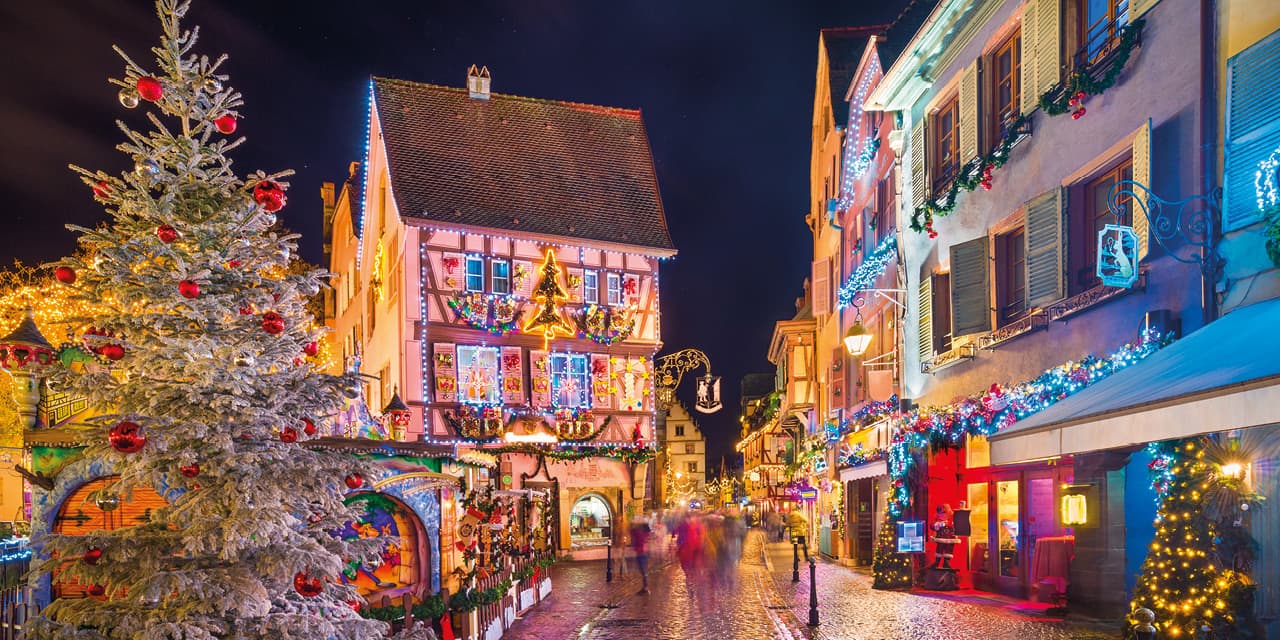
Vineyards are bleak in winter. The vines are dormant, all essential maintenance is complete, it’s cold and it’s lonely and there’s nothing to do but wait for spring. Yet there is a wine region that is a winter wonderland; a land of fairytale villages, cobbled streets, castles and snow-capped hills.
This is Alsace, a long, slim valley in northern France, squeezed between the Rhine and the Vosges mountains. A place where history, geology and climate combine to create a unique wine region.
Across the Rhine is Germany, and Alsace has frequently flipped between French sovereignty and German occupation. Every fairytale village has a war memorial, a solemn reminder that Alsace is a pretty place with a bloody past. Today Alsace is French with a German character; reflected in its half-timbered houses, family names, hearty cuisine and tall flute-shaped wine bottles.
The landscape is shaped by geological upheaval. The best vineyards find shelter in the folds and foothills of the mountains where the vines exploit a mosaic of soil, slope and aspect. Each vineyard site is uniquely suited to one of the region’s seven principal grape varieties. In Alsace the importance of grape variety is such that, unusually for a French wine region, the label will tell you what you are drinking.
Out of the seven grape varieties these four Noble Varieties are worthy of particular attention: Riesling is the queen with its green apple flavours, racy acidity and exceptional ageing potential; blousy Gewürztraminer can be dry or off dry with distinctive aromas of rose petal and lychee; Alsatian Pinot Gris is rich and oily with pear and apricot flavours, the same grape but a world away from cheap Italian Pinot Grigio; Muscat is less widely planted, typically vinified dry and one of the only wines of the world that smells of grapes.
Alsace may be famous for its white wines but at the time of the Holy Roman Empire Pinot Noir was the most planted and most celebrated wine of Alsace. Today Pinot Noir is making a comeback, increasingly valued by a new generation of well-educated, well-travelled winemakers.
Protected by the mountains, the vineyards enjoy long, dry, sunny autumns in an otherwise cool climate. In these conditions grapes can hang longer on the vine, slowly accumulating sugar while retaining vital acidity. These conditions give the winemaker options to produce wines in a wide range of styles from bone dry to lusciously sweet.
As well as sweet or dry, white or red, Alsace also offers a choice of still or sparkling. Crémant d’Alsace was the first Crémant in France; a sparkling wine made by the Champagne method but using local grape varieties. Now a third of all wine from Alsace is sparkling and the region produces more Crémant than any other French region.
After a bracing hike through the vineyards, enjoy a hearty lunch in a cosy, rustic tavern, known locally as a winstub or wine room. Traditional Alsatian cuisine is perfect after a winter walk. Try coq au Riesling, chicken braised slowly in Riesling with mushrooms and cream and served with spaetzle noodles. A Germanic influence is evident in dishes such as choucroute garnie, a bowl of sauerkraut flavoured with Riesling or juniper berries, served with pork and potatoes. Baeckeoffe is a mix of meats, sliced potatoes, onions and white wine baked in an earthenware dish. Finally, tarte flambé or flammekueche is a thin pastry tart topped with crème fraîche, sliced onions and lardons. All should be washed down, of course, with a bottle of the local wine.
After a heavy lunch there’s nothing better than a snooze in front of an open fire with a whiff of wood smoke, the spit and crackle of the burning logs and a dream of spring.
The Wine List
Levi Serafino Bianco Vermouth di Arneis Cave de Turckheim Gewurztraminer, Waitrose, £12.00
Domaine Zind-Humbrecht: Pinot Gris 2022, District, Whitley Bay, £28.00
Domaine Bott-Geyl, Points Cardinaux Métiss, VIN, Gateshead, £21.00
Famille Hugel ‘Classic’ Riesling, Majestic, £23.50
Domaine Leon Boesch ‘Les Jardins’ Pinot Noir, Cavavin, £29.99

David Harker’s journey in wine has seen him progress from complete novice to a Wine & Spirit Education Trust Diploma-certified wine educator, accredited Bordeaux and Sherry wine educator, Spanish Wine Scholar and – in a We Bought a Zoo moment – wine school owner. To explore Newcastle Wine School’s events, tastings and courses visit www.localwineschool.com/newcastle